Join us as we walk through how SOURCIX is transforming custom mechanical sourcing with AI – breaking down the challenges teams face today and how structured data and intelligent workflows can unlock faster, smarter procurement decisions.
In this session, you’ll learn how modern sourcing teams can:
- Navigate shifting supply chains, tariffs, and global supplier constraints
- Eliminate fragmented, manual RFQ workflows
- Expand beyond legacy supplier networks without increasing risk
- Turn unstructured engineering data into actionable sourcing intelligence
- Leverage AI for supplier matching, price benchmarking, and decision support
- Maintain control while scaling sourcing operations
- Protect IP and improve collaboration across the sourcing lifecycle
…and more!
Watch the Webinar
Transcript
Ofer:
“Because this is a lecture about AI, I asked Claude to give me a joke. I didn’t like it, so I asked for a quote instead. He came back with one from Larry David, the creator of Seinfeld. And since you can all immediately see why it caught my attention, I decided to keep it.
‘Anyone can be confident with a full head of hair. But the confident bald man – there is your diamond in the rough.’
So with that as our AI-generated opening, let me introduce SOURCIX.
SOURCIX is a venture-backed startup focused on solving the pain of sourcing custom mechanical parts. We support clients in the U.S. and Israel through a network of 200+ manufacturers across 14 countries, serving industries like quantum computing, space, drones, robotics, and more.
Before we get into the solution, it’s important to understand what changed. Custom mechanical sourcing has become significantly harder – tariff volatility, unstable supplier availability, long lead times, and constant geographic shifts.
So the challenge is no longer just finding a supplier – it’s navigating a moving target. Cost, capacity, geography, and compliance are all changing at once.
And when things get harder, the weaknesses in the current workflow become clear.
A drawing or BOM comes in. Specs are extracted manually. Buyers search through spreadsheets and networks. RFQs go out with inconsistent information. Quotes come back in different formats and are normalized manually.
It’s fragmented, manual, and hard to scale.
But the biggest bottleneck isn’t just the manual work – it’s that buyers are constrained by the suppliers they already know.
Bringing in new suppliers introduces risk. Existing ones are easier to justify. So even when better options exist, teams fall back to the same vendors. Not because buyers are doing a bad job – but because the system makes expansion difficult.
So the question is: how do you break that constraint without adding more work or more risk?
That’s where AI comes in.
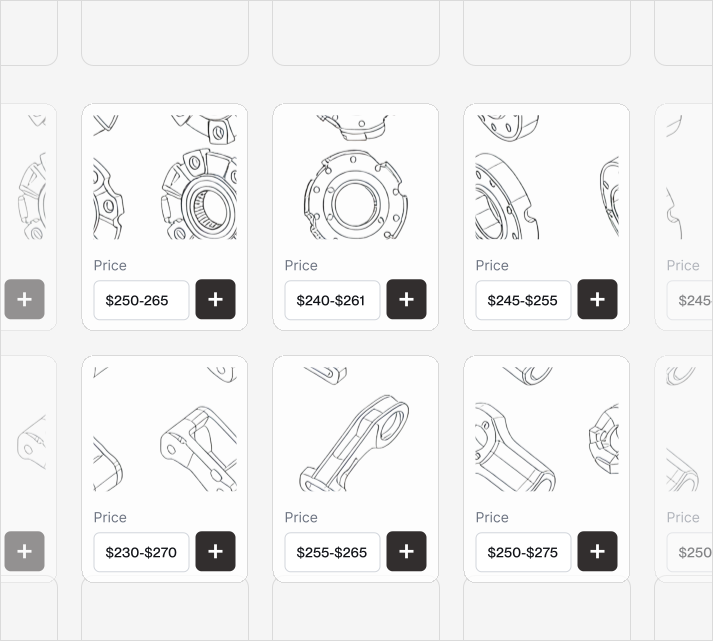
We turn messy, unstructured engineering data into structured sourcing intelligence. Inputs like drawings, BOMs, supplier responses, and certifications are transformed into fields like material, tolerances, geometry, and process type.
Once the data is structured, intelligence becomes possible – vendor matching, process prediction, similarity search, and sourcing recommendations.
AI doesn’t replace sourcing judgment – it creates the foundation for better decisions.
It’s not a black box. It’s a set of targeted capabilities: drawing verification, anonymization, BOM classification, vendor matching, and price analysis – combined with both your supplier network and ours.
The result is that buyers can move faster, expand their supplier base, and still stay in control.
Take supplier matching as an example. The buyer defines constraints – process, geography, certifications, quantity, lead time, price – and the system filters thousands of suppliers into a qualified shortlist, then ranks them.
So instead of searching, the buyer starts with the best options and focuses on making decisions. That’s the shift.”
Or:
“What we’re showing in the platform is not a new process – it’s the same sourcing lifecycle: RFQ, bidding, quoting, production. What changes is how it’s executed.
You create an RFQ, upload files, and the platform analyzes them automatically. It extracts technical data and builds the structured metadata needed for accurate matching.
You define production requirements – materials, quantity, quality, certifications – and commercial constraints like timelines.
Then the platform matches relevant suppliers. You can control geography, combine your own vendors with our network, and protect IP through anonymization.
Once released, suppliers submit structured quotes. You get a centralized view – pricing, lead times, shipping, and technical notes – all in one place.
You can compare offers across regions, see breakdowns, and even get optimized supplier combinations.
After ordering, you manage production, communicate with suppliers, and track everything in the platform. All quality reports and history are stored for reuse.
The idea is simple: same process, but smarter, more structured, and more controlled. The job itself hasn’t changed – but the scale and complexity have.
We help buyers and engineers use data – both internal and external – to make better decisions. Not by fully automating the process, but by making every step more intelligent.”
Ofer:
“AI is a major shift, but the goal is practical. It helps you scale, handle complexity, and connect data across parts, suppliers, and decisions.
But people still apply judgment and context.
We often say: scaling doesn’t come from better suppliers – it comes from better procurement infrastructure. That’s what we’re building.”
Or:
“The platform is available today. You can upload a project and see results immediately.
We focus on structuring sourcing data and improving how the process runs. Going forward, more automation and AI agents will continue to enhance this – but the system remains flexible to how each customer works.”
Q&A
Q: Is this only for custom parts or also off-the-shelf components?
Or:
“Our core focus is custom mechanical parts. Off-the-shelf components can be included within assemblies, but for purely catalog sourcing, other tools may be more optimized.”
Q: Can I upload a BOM from our PLM system?
Or:
“Yes. We support integrations, including lightweight options using agents or Excel workflows.”
Q: What happens if something goes wrong after ordering?
Or:
“If you source through our network, we provide full support and guarantees. You can open tickets, communicate with suppliers, and manage everything centrally.
Because we match based on real capabilities and historical data, issues are reduced – but when they happen, we handle them.”
Q: What about security and compliance?
Or:
“We comply with standards like SOC 2, use encrypted infrastructure, and provide anonymization to protect IP. Compared to email workflows, this is significantly more secure.”
Q: Who typically uses the platform?
Or:
“It’s flexible – used by engineering, procurement, and operations teams, from prototyping to full production.”
Or:
“If there’s one thing to take away: we’ve built a structured, centralized way to make sourcing decisions for custom mechanical parts.
You can try it today – upload a project and see results immediately.”